
NSYNC ITB Ticketing - Überlastschutz für Ihre Systeme
During mass loads, thousands of data records often arrive simultaneously in integration scenarios. Receiving systems and their APIs come under heavy load, respond slowly, or fail completely. Imports abort, and the effort required for complex rework increases. The NSYNC ITB Ticketing module absorbs this load completely and delivers the data to target systems in measured doses – only as fast as the target system can securely process the data. Uncontrolled load peaks are transformed into a predictable, steady flow.
How NSYNC ITB Ticketing ensures your API stability – Request live demo now
Advantages of NSYNC ITB Ticketing
NSYNC ITB Ticketing addresses the specific challenges within your (Azure) integration landscape. Choose your role to discover how we can make your daily work more efficient:
NSYNC ITB Ticketing protects your mission-critical systems from overload during mass data processing. Instead of risking uncontrolled traffic spikes that lead to target API failures and costly process aborts, Ticketing actively controls data throughput. You gain a predictable, robust integration landscape where your target systems always operate within their capacity limits.
Your added value at a glance:
-
System stability: Receiving systems remain fully available and responsive even under high mass loads.
-
Minimized downtime risk: No API overload, no aborted imports, and significantly fewer operational disruptions.
-
Predictable operations: Enables the mass processing of large data volumes without putting ongoing business operations at risk.
-
Data sovereignty: Ticketing runs entirely within your Azure subscription. Your data stays in your environment.
- Investment protection: Through intelligent load management, Ticketing prevents (API) failures in legacy systems and minimizes operational risk during high data volumes.
NSYNC ITB Ticketing implements robust rate limiting and load leveling directly into your Azure integration stack. Mass data frequently causes target APIs to return HTTP 429 errors (Too Many Requests). Ticketing solves this using a "token bucket" logic: Every data record pulls a ticket. The Azure Function only releases as many tickets per time window as the target system can safely process.
Your technical added value:
- Configurable rate limiting: Configure throughput precisely according to your target API's capacity limits (concurrency control).
- Intelligent buffering: Excess load is not discarded, but held in the queue and processed incrementally according to schedule.
- Persistent state management: The current throttle state is stored globally in an MS SQL Azure Database – ensuring load control remains consistent across all function instances and reboots.
- Error prevention: Active backpressure management prevents cascades of HTTP 429 errors and timeouts.
- API protection: Legacy APIs that cannot handle parallel requests are securely protected via request queuing, covering both the sending and receiving sides (polling/triggering).
NSYNC ITB Ticketing ensures controlled utilization and protects your target systems. Instead of addressing API instabilities through manual throttling or complex firewall rules, Ticketing automates load leveling. The system integrates seamlessly into your Azure infrastructure and ensures a steady, healthy data flow.
Your operational added value:
-
Stable target systems: APIs and backends remain protected from overload because the inflow is actively throttled.
-
Backpressure instead of error floods: Prevents cascading errors and timeouts through intelligent buffer management.
-
Secure operation: Complete integration into the customer's Azure tenant – no external data storage required.
-
Low-maintenance architecture: The system is based on Azure Functions and MS SQL Azure Database – there are no further dependencies or third-party services.
Ticketing — Rate Limiting & Load Leveling for Receiving Systems
The NSYNC ITB Ticketing module acts as a dynamic "load leveler" for your Azure integration landscape. It decouples the incoming data stream from the throughput capacity of the target API.
How Load Control Works
- Status Quo: Unfiltered mass data streams frequently lead to capacity overruns in target APIs. This results in HTTP 429 errors or timeouts that block entire integration chains and require manual retry runs.
- The Solution: Ticketing acts as an intelligent buffer. Using the token bucket mechanism, the load is actively adapted to the target system's capacity. Messages are delivered in measured doses, which stops the flow of errors and permanently ensures system health.
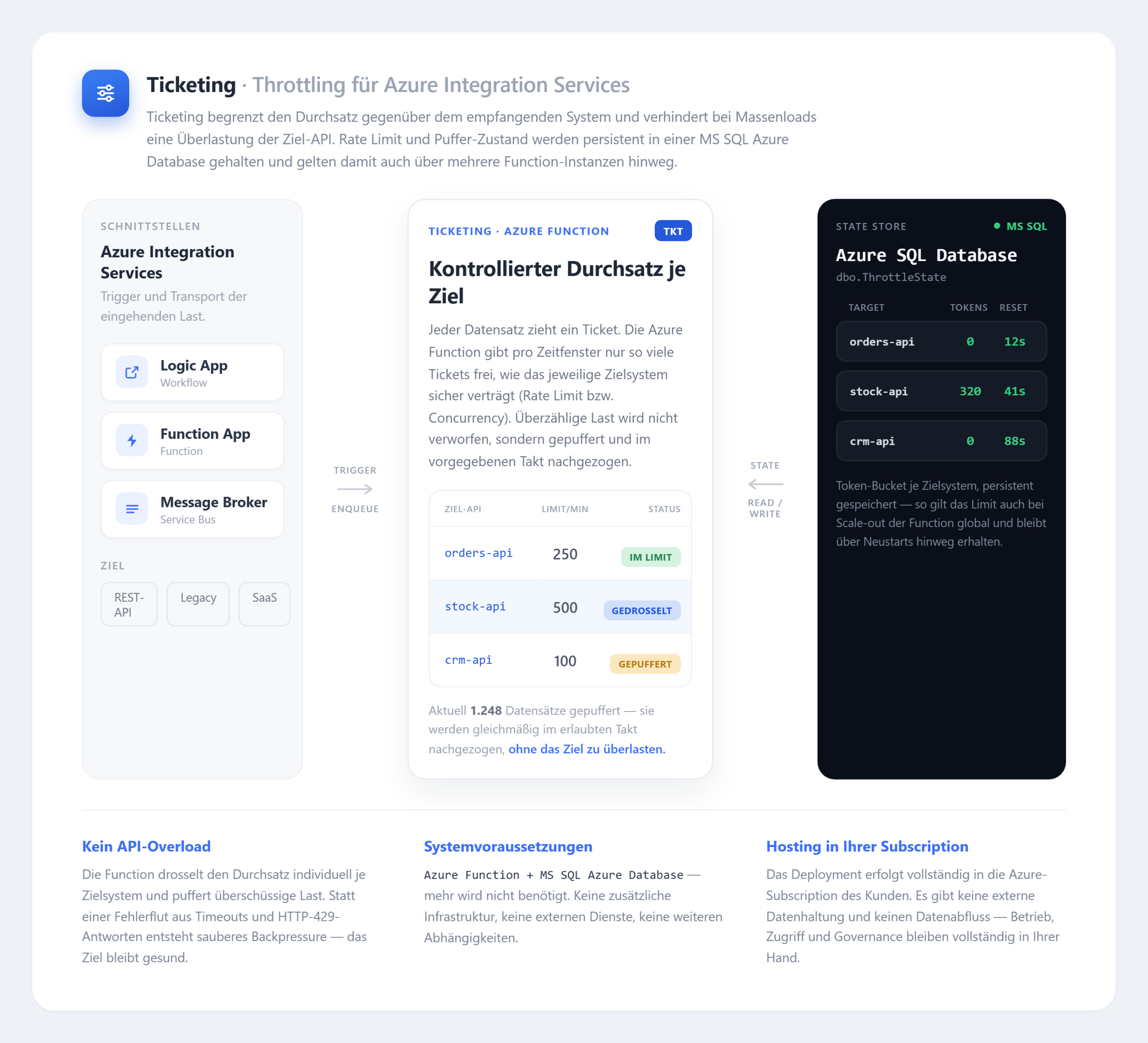
NSYNC Integration:Toolbox Ticketing - Architecture
- Status Quo: Legacy systems are often not designed for the high demands of modern integration scenarios. Parallel data access frequently leads to unstable APIs, system outages, and costly process aborts.
- The Solution: NSYNC ITB Ticketing proactively protects these systems. Through intelligent request queuing, data requests – whether via polling or triggers – are delivered in measured doses. This guarantees stable, predictable operations without overloading your legacy systems.
Core Functions
Ticketing has a modular design and integrates flexibly into your Azure integration architecture.
- Integration: Azure Logic Apps and Function Apps via message broker (Service Bus).
- System Requirements: Azure Function + MS SQL Azure Database – no further dependencies.
- Hosting: Runs entirely within the customer's Azure subscription, no external data storage.
- The Result: Backpressure instead of error floods – no timeouts, no HTTP 429 cascades, the target system stays healthy.

NSYNC Integration:Toolbox Ticketing - Example
Get in touch
Your contact person: NSYNC Product Team
E-mail: info@nsync-group.com
| Phone: +41 52 577 70 70