
NSYNC Sky:Port — Integration between On-Premises and Azure Cloud
NSYNC Sky:Port is the specialized "listener" and "transporter" that seamlessly connects your local file systems with the Azure cloud. Instead of laboriously querying data from individual systems, NSYNC Sky:Port monitors local data folders as well as Azure storage locations in real time. As soon as a file is ready, NSYNC Sky:Port pushes it securely and with high performance into the Azure world – and vice versa. The result is a hybrid environment where data flows without you having to open your local infrastructure for deep cloud integrations.
The path from local file directories to the Azure cloud or vice versa is both a security and operational issue in many companies: Traditional solutions require incoming firewall permissions – and thus potential attack surfaces within your own network. NSYNC Sky:Port takes the opposite approach. As a Windows service within your own network, the software actively establishes every connection from the inside out. Only outbound traffic needs to be permitted; no incoming port is opened. Security and simplicity do not have to be a contradiction. Sky:Port bridges the gap between on-premises and Azure – without compromising network security.
For management purposes, NSYNC Sky:Port integrates seamlessly into the SYMON UI Framework.
How NSYNC Sky:Port secures your data/file integration – Request live demo now
Benefits of NSYNC Sky:Port
We developed NSYNC Sky:Port with the goal of making the bridge between on-premises and cloud as simple and secure as possible, while eliminating the limitations of the Microsoft On-Premises Data Gateway (OPDG) and other tools.
Security and simplicity do not have to be a contradiction. NSYNC Sky:Port transforms data/file integration into a transparent asset that seamlessly connects your Azure cloud with your local infrastructure – without compromising your company's security architecture. We bridge the gap between on-premises and cloud by eliminating complexity and minimizing the attack surface to near zero.
Your added value at a glance:
-
Zero-Trust Network Architecture: Thanks to our "outbound-only" technology, no incoming firewall ports are required anymore. You eliminate potential attack vectors at the critical perimeter interface.
-
Maximum Data Sovereignty: Sky:Port operates entirely within your own infrastructure. Your sensitive data never leaves your controlled environment at any time.
-
Risk Minimization & Business Continuity: Through the automated reprocessing mechanism, we prevent the loss of critical business data during connection errors and reduce manual process costs to virtually zero.
-
Bidirectional Integration: Secure file transfer from on-premises to Azure and back in a single solution.
NSYNC Sky:Port transforms file transfer into a secure outbound-only architecture without restricting connectivity. Instead of managing complex firewall rules for inbound connections, the component uses an intelligent connection model that initiates all communication from within your network. This massively reduces the attack surface while providing maximum data integrity and process security through automated reprocessing and high-performance streaming.
Your technical added value:
-
Outbound-only File Transfer: The service initiates all connections itself; firewall rules are limited to outbound HTTPS (TCP 443).
-
Event-driven: Monitors local directories (polling) in real time and responds immediately to new files.
-
Performance: Streaming architecture for minimal latency and low system resource consumption.
- Connection Model: The service transfers files via HTTPS into Azure target containers (Blob Storage). The reverse direction – Azure → On-Premises – is handled over the same connection established by the service, meaning no inbound rules are required on the firewall.
-
Data Integrity: If a transfer aborts – due to network or connection errors, for example – the affected file is automatically re-queued for processing (reprocessing).
- Non-invasive Integration: Your legacy systems do not need to be modified. NSYNC Sky:Port docks from the outside and modernizes the data flow without interfering with existing, sensitive processes.
NSYNC Sky:Port relieves your IT operations through highly available, autonomous operation of data/file integration. Instead of managing manual interventions during connection drops or complex firewall configurations, Sky:Port automates the entire transfer process. The solution integrates seamlessly into your Windows infrastructure and ensures a stable, low-maintenance data flow between on-premises and Azure.
Your operational added value:
- Flexible configuration: Connection of data folders configurable via configuration file or seamless integration into the SYMON UI Framework. You define which local folders NSYNC Sky:Port is allowed to "see".
- Low maintenance: Runs continuously in the background as a Windows service and starts automatically with the system. No extensive rights required for third-party systems or cloud workflows.
- Versatile connectivity: Support for FileSystem, Azure Blob, and SFTP targets. Triggers from Service Bus, Event Hub, and Storage Queues (file located in Azure Blob).
- Maximum reliability: Integrated error handling and automatic retry logic (reprocessing) guarantee that no data packet is lost – even with unstable connections.
- Intelligent distribution: NSYNC Sky:Port can distribute data simultaneously to different recipients (e.g., archive in Blob Storage + trigger for Service Bus + partner via SFTP).
Sky:Port — Outbound-only Data/File Integration as a Windows Service
NSYNC Sky:Port bridges the gap between local file systems and Azure Blob Storage without compromising network perimeter security. The component runs as a Windows service within the customer network and initiates all connections itself.
NSYNC Sky:Port adapts to your workflow: You can configure the connection of your data folders either directly via the SYMON UI or classically via a configuration file. This enables seamless integration into automated deployment processes and Infrastructure-as-Code scenarios.
NSYNC Sky:Port - Architecture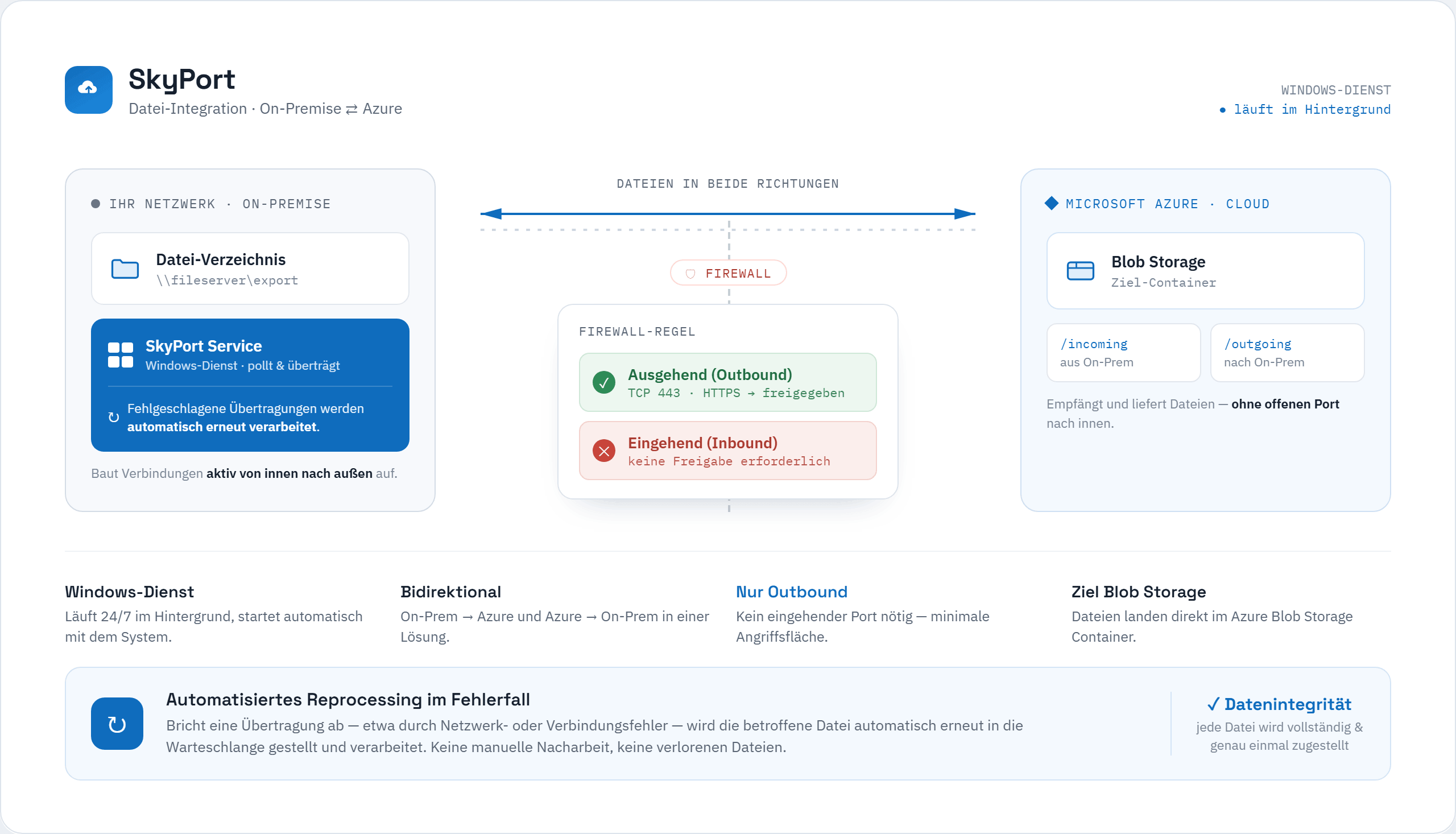
Hybrid Cloud Integration
- Status Quo: The connection of local data folders to Azure is often fragmented, as different systems have varying requirements for storage and transmission protocols.
- The Solution: Sky:Port acts as a central, high-performance data hub. By supporting diverse input sources and output targets, isolated local data is seamlessly integrated into the cloud architecture.
Network Security & Perimeter
-
Status Quo: Traditional solutions for file transfer often require inbound firewall permissions, which weakens the security of your own network and creates potential attack surfaces for unauthorized access.
-
The Solution: Sky:Port consistently works with an outbound-only model. Since the Windows service proactively establishes the connection from the inside out, the network remains "closed" to the outside; no inbound ports are required.
Data Integrity & Process Security
- Status Quo: During network or connection interruptions during the transfer, files often get stuck in an undefined state, requiring manual intervention and tedious checks.
- The Solution: An intelligent reprocessing mechanism detects connection drops in real time. Affected files are automatically re-queued for processing to ensure exact delivery without manual effort.
Core Functions
Ticketing is modularly structured and can be flexibly integrated into your Azure integration architecture.
-
Input Sources: FileSystem, Azure Service Bus (trigger, file in Azure Blob), Event Hub (trigger, file in Azure Blob), Storage Queues (trigger, file in Azure Blob).
-
Output Targets: FileSystem, Azure Blob, SFTP.
-
Security: Support for modern encryption and authentication standards.
-
Operation: Runtime as a Windows service, automatic system start, permanent background operation.
-
Firewall: Outbound 443/HTTPS only – minimal perimeter configuration.
- Performance: Streaming architecture for minimal latency and low resource consumption.
Get in touch
Your contact person: NSYNC Product Team
E-mail: info@nsync-group.com
| Phone: +41 52 577 70 70